Check your bill first: Groton Utilities or Eversource
Before you ask for a solar price, read the utility name at the top of your electric bill. System size, the credit for each solar kWh, the rebate and the battery program all follow from it.
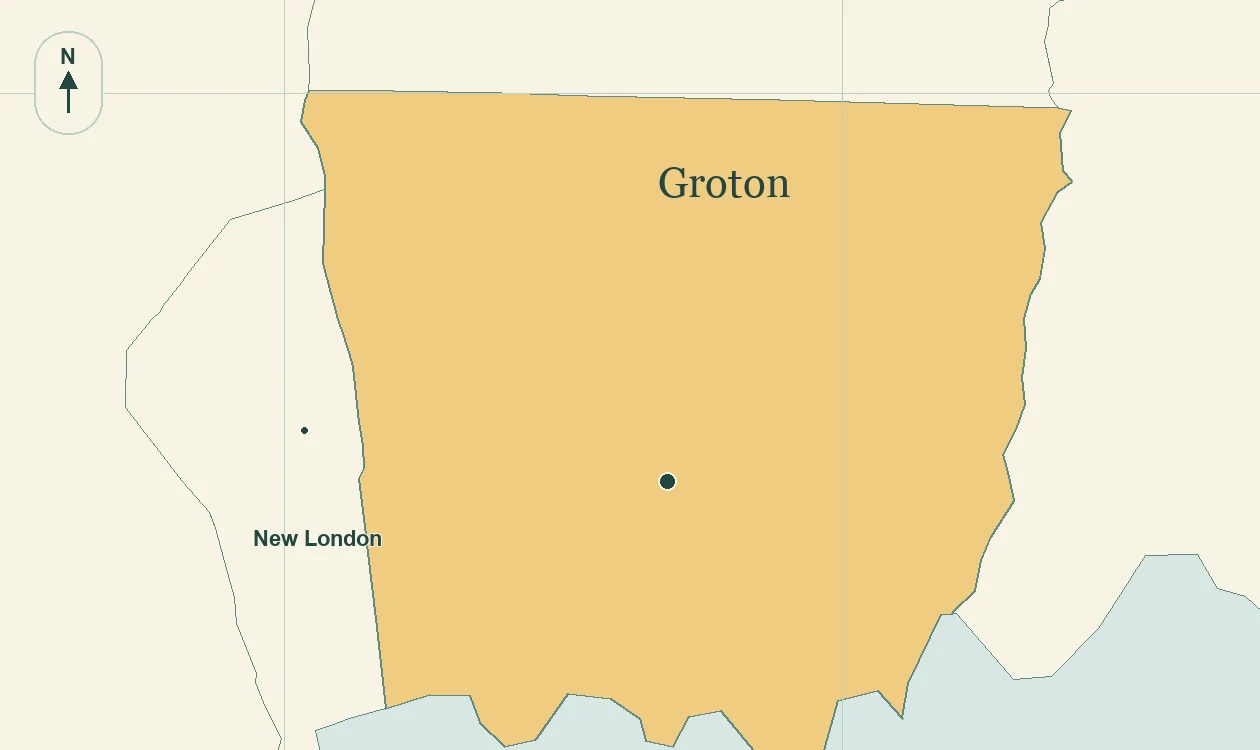
Groton is one of six Connecticut places where the Office of Consumer Counsel lists the town as the electric provider. Groton Utilities (GU), owned by the City of Groton, distributes power throughout the City and in portions of the Town. Eversource serves the rest of the Town.
So the dividing line runs through the Town, not along the City and Town border. The Town's streetlight map shades a GU area and an Eversource area, but no public parcel-level map of the line turned up. If you live in Noank, Groton Long Point or on the Groton side of Mystic, don't assume. Your bill is the test, not your ZIP code or what a neighbor was told.
You'll see two units on any proposal. A kilowatt (kW) measures system size; quotes usually state kW DC, the panels' rated output. A kilowatt-hour (kWh) measures energy over time, the number on your bill. Sizing turns yearly kWh into kW.
| Groton Utilities address | Eversource address | |
|---|---|---|
| Size rule | Up to 100% of your highest yearly use in the last five years, plus EV and heat-pump allowances | 25 kW cap for one- to four-unit homes; ask how the installer sized it |
| Credit per solar kWh | 9.581¢ plus adjustments (2026 rates) | Buy-All 32.89¢, or Netting: retail credit with a 4.02¢ charge on production (2026 applications) |
| Upfront rebate | SolarPlus, up to $10,000 | SolarPlus does not apply; the RRES payments are the incentive |
| Battery program | Energy Storage Solutions is offered to Eversource and UI customers; ask GU how storage counts | Energy Storage Solutions (ESS) |
| Ownership | Owned or financed; no lease or power purchase agreement (PPA) | Lease and PPA allowed |
A Groton proposal that does not name your utility is not about your house yet.
On Groton Utilities, your own usage caps the system
GU's guidance on choosing an installer bases the size recommendation on your highest average annual use over the last five years, and GU's SolarPlus rules cap capacity at 100% of your kWh usage. Ask the installer which year they used, then check it against your own bills.
Guessing high is the costly mistake. GU's net metering rider, the rate schedule for customers with solar, sits in City of Groton Ordinance 247. It says credits "will cease in the event that the customer is a net generator within any 12 month period." A net generator sends GU more kWh than it takes over a year. A system sized "for the future" can lose its credits. The same ordinance adds a second limit: the array's capacity may not exceed the customer's peak demand. Ask the installer, or GU, how that applies to your house.
Each solar kWh is also worth less here than on Eversource, mainly because GU power is cheaper to begin with. GU's standard residential energy charge is 13.696¢ per kWh (2026 rates, billed from April 1, 2026). EcoGen puts the value of Eversource home power at 26.16¢.
The solar rider splits GU's price in two. GU credits every kWh you send back at its 9.581¢ energy charge plus purchased-power and transmission adjustments. It also bills a transmission and distribution charge of 4.116¢ per kWh on your household's complete requirement, including solar you use yourself. The two pieces add back up to the standard rate (9.581¢ + 4.116¢ ≈ 13.70¢). So a kWh you use and a kWh you export are worth about the same: roughly 9.6¢ plus adjustments. The adjustment amounts were not published in readable form, so ask GU for the current figures before you compare offers.
GU's proposed 2027–2029 rates keep the 9.581¢ credit and the net-generator clause; whether they were adopted after the November 16, 2026 hearing was unconfirmed on November 18.
The system must also be customer-owned or financed. GU says its customers cannot use a PPA, and SolarPlus excludes third-party ownership. Treat a lease or PPA pitch at a GU address as a reason to call GU before going further.
Plan an EV or heat pump before sizing
GU allows an extra 3,285 kWh a year for each electric vehicle, 3,608 kWh for a whole-home air-source heat pump and 2,458 kWh for a ground-source heat pump. If one is coming, tell the installer before sizing, and ask for the allowance as its own line in the math. In the example further down, one EV moves the size ceiling from about 7 kW to about 9.5 kW.
Reserve SolarPlus before anything goes on the roof
GU's rebate pays only if the steps run in order. The SolarPlus program details set the terms:
- Amount. $1,000 per kW, capped at 50% of installed cost (excluding tax) and at $10,000.
- Size. Up to 12 kW AC per meter. AC is the inverter's output rating, usually below the panels' DC rating.
- Shade. A shade study is required; shading must be under 30%.
- Timing. Reserve before installation, then install within six months.
- Equipment. A 20-year performance warranty, an automatic grid disconnect and an AC disconnect GU can reach.
- Sign-off. City or Town electrical permit and wiring inspection, then GU's inspection, a bi-directional meter and Permission to Operate (PTO), GU's written go-ahead to switch on.
GU's 2026 form covers installs through December 31, 2027, yet says requests must be postmarked by January 31, 2027, and GU does not post how much money is left. Ask GU about both before you sign.
Make the reservation a condition of the contract: no work starts until GU confirms it in writing. Also ask whether the rebate is counted on DC or AC kW. In the example below, that choice moves the rebate by $1,000.
On Eversource, choose Buy-All or Netting first
If your bill says Eversource, most of the GU rules above fall away. No usage-based size limit turned up for Eversource homes, SolarPlus does not apply, and leases and PPAs are allowed. In their place comes one choice that lasts 20 years.
The rules come from the statewide Residential Renewable Energy Solutions tariff (RRES), set under the Public Utilities Regulatory Authority's RRES program. You pick one of two payment routes:
- Buy-All. Eversource buys every kWh produced at 32.89¢ (applications submitted in 2026). Your household use is billed as before.
- Netting. Exports are credited at full retail, and a 4.02¢ Solar Energy Adjustment is charged on all production (applications submitted in 2026).
You elect at interconnection, the step where the utility approves connecting your system to its grid. Rates for 2027 applications were not set as of November 18, 2026, so ask which year's rate the numbers assume.
RRES caps one- to four-unit homes at 25 kW. Ask how the installer sized the system and what share of your yearly use it covers.
Groton adds one risk a single-utility town doesn't have: a proposal built on the wrong rule set. A GU-style usage cap can trim an Eversource system for no reason, and a Netting value, lease offer or ESS payment can turn up on a GU address where none of them apply. Check each line against your utility's column in the table above.
Then ask for the first-year value under both routes. Buy-All pays a set rate; Netting moves with your retail price.
Same roof, two utilities: an illustrative Groton comparison
Illustrative calculation. A Groton home whose highest yearly use in five years was 9,000 kWh (illustrative). Production of 1,294 kWh per kW per year and a price of $2.80 per watt are State benchmarks from EcoGen's Connecticut solar cost page (September 2026 edition). EcoGen calls $2.80/W a modeled installed price before incentives, not a quote, and 1,294 kWh/kW is statewide, not your roof.
| Illustrative calculation | Groton Utilities address | Eversource address |
|---|---|---|
| Size ceiling | 9,000 ÷ 1,294 ≈ 6.96 kW; with one EV, 12,285 ÷ 1,294 ≈ 9.49 kW | No usage ceiling found; 25 kW cap |
| Design | 6.5 kW → 8,411 kWh, 93% of use, still a net consumer | 6.5 kW, same output |
| Price (State benchmark) | 6.5 kW × $2.80/W = $18,200 | $18,200 |
| Utility rebate | SolarPlus $6,500 on 6.5 kW, or $5,500 on a ~5.5 kW AC inverter | None |
| Price after utility rebate | $11,700, or $12,700 on the AC basis | $18,200 |
| Interconnection | $100 Category 1 fee (GU 2015 guidelines) + $230 meter | $163 application + $230 meter (per EcoGen) |
| Value per kWh | ≈ 9.6¢ plus adjustments (2026 rates) | Netting ≈ 26.16¢ − 4.02¢ ≈ 22¢; Buy-All 32.89¢ |
| First-year value | ≈ $806 plus adjustments | Netting ≈ $1,862; Buy-All ≈ $2,766 |
Netting uses EcoGen's 26.16¢ Eversource home power value (23.60¢ with temporary credits to April 30, 2027).
At the GU address, solar is a smaller, rebate-led decision: a capped size, a lower credit, and a rebate worth roughly a third of the benchmark price. At the Eversource address, the decision is the 20-year Buy-All or Netting election, with size less tied to past use. Two identical roofs a few streets apart should get different proposals. If yours look the same, ask each installer which utility rule they applied.
The example gives no payback years. The GU adjustments are unknown, and payback depends on financing and future rates.
City or Town: which office permits your array
Groton has two building authorities, and they do not line up with the two utilities. Ask the installer which office they will file with.
| Your address | Permit office | Historic body | Utility |
|---|---|---|---|
| City of Groton | City of Groton Building & Zoning, 295 Meridian St, PermitLink online | Eastern Point Historic District Commission | Groton Utilities |
| Town of Groton | Town of Groton Inspection Services, 134 Groton Long Point Rd, Citizen Self-Service portal | Town Historic District Commission | GU or Eversource, by address |
A Town address means checking permit route and utility separately. The Town's website did not load on November 18, 2026, and its portal details come from a recent archived copy, so confirm them with Inspection Services.
Directories that say the town approves interconnection mix up two jobs. The City or Town issues permits and inspects the wiring. The utility approves the connection; at a GU address, GU inspects, installs the meter and issues PTO.
A workable order at a GU address:
- Reserve SolarPlus and get GU's confirmation in writing.
- Get a Certificate of Appropriateness if you are in a historic district.
- File building and electrical permits with the City or Town.
- Submit GU's interconnection application with a one-line diagram, site plan and estimated production.
- Install within six months of the reservation; pass the wiring inspection.
- GU inspects, swaps the meter and issues PTO.
On Eversource, step 1 drops out, and the application and Buy-All or Netting election go to Eversource.
Historic districts and the water view
Historic review splits along the same City and Town line, and the water widens it.
In the City, the Eastern Point Historic District handbook lists "solar panels or wind powered energy devices" as regulated when in public view, and counts navigable waterways as public view. A rear roof hidden from the street can still be visible from a boat. The Building Official requires a Certificate of Appropriateness (COA), the commission's written approval, before issuing a building permit. The handbook dates from 1998; ask whether a newer version applies.
In the Town, a separate Historic District Commission covers Mystic, Center Groton and Burnett's Corners; the Town Clerk holds the boundaries.
State law limits both commissions. Under CGS §7-147f, a COA for a solar energy system cannot be denied unless the system cannot be installed without substantially impairing the district's historic character. The commission may require design or location changes that do not significantly impair the system's effectiveness.
In a district, ask which roof faces are visible from the street or the water, and what moving panels to a less visible face would cost in yearly kWh. That figure tells you whether to accept a condition or push back on it.
Backup goes on its own quote, and your utility changes it
GU's SolarPlus rules require an automatic grid disconnect, so the array drops off when the grid fails. Panels alone won't keep the refrigerator running. Backup needs a battery and wiring for the circuits you want powered.
Start with a critical-loads list: the circuits that must run in an outage, such as the refrigerator, sump or well pump, boiler controls, medical equipment, Wi-Fi and some lights. Size the battery to that list, not the whole house, and ask how long it runs from a stated starting charge. In Groton, the list is only half the job. Your utility decides what the battery can earn and which questions you must put to it in writing.
At an Eversource address, a battery can enroll in Energy Storage Solutions, the program for Eversource and UI customers. For applications from April 1, 2026, it pays $30 per kWh upfront ($130 in Grid Edge areas) and $300 per kW a year for ten years, depending on performance during discharge events, when the program calls your battery to send power to the grid. Expect about 50 in summer and 5 in winter. Each one draws the battery down, so ask for the outage reserve: the share held back for when the power fails. An ESS enrollment without a stated reserve has not answered the backup question.
At a GU address, ESS does not apply. GU's 2026 SolarPlus form mentions "$1,000 per KW of Generation/Storage" and asks for battery kWh, but how a battery counts toward the rebate, and whether the 50% cap includes battery cost, is not spelled out. Ask GU in writing before the battery enters your rebate math.
In a City flood zone, the City's zoning regulations require a Floodplain Development Permit before development, and the bottom of electrical equipment, including junction and circuit-breaker boxes, must sit 1 foot above base flood elevation (BFE), the level a 1%-a-year flood is expected to reach. Ask City Building & Zoning whether that covers your battery, inverter and backup subpanel. A basement spot may not work.
Check Quote A's price per watt
With the battery on its own quote, divide the solar-only total by DC watts.
Illustrative example. A solar-only Quote A of $21,600 for 7.2 kW DC is $21,600 ÷ 7,200 W = $3.00 per watt, inside the $2.46–$3.14 range EcoGen gives for typical Connecticut written quotes (State benchmark). Fold in a battery EcoGen models at $13,500 and the total becomes $35,100, or $4.88 per watt.
A figure that far above the range suggests a battery, roof work or panel upgrade is sitting inside the solar line. Take those out before you divide, then compare.
Check the incentive lines too. The federal residential clean energy credit (25D) is unavailable for property placed in service after December 31, 2025, batteries included. A proposal that still subtracts it is out of date.
How the proposed two-quote service would work in Groton
The proposed New London Solar service would separate everyday solar from backup. Coverage of Groton is proposed and not yet confirmed. After an on-site assessment, the Proposed service would hand you:
- Quote A, solar only (Proposed service). Roof layout, panel count, DC and AC ratings, yearly kWh with shade assumptions, total price and price per DC watt. It names your utility and route: GU rider plus SolarPlus reservation, or Eversource Buy-All or Netting. At a GU address it shows the five-year usage figure and any EV or heat-pump allowance.
- Quote B, optional backup (Proposed service). Your critical-loads list circuit by circuit, usable kWh, continuous and surge kW, and runtime under stated assumptions. On Eversource it states ESS enrollment and the outage reserve. On GU it records GU's written answer on storage. In a City flood zone it shows battery and breaker-box height against BFE.
- Circuit map (Proposed service). A labeled panel schedule marking backed-up circuits.
- Responsibility sheet (Proposed service). Who files the City or Town permits, any Eastern Point or Town COA, a City floodplain permit, the SolarPlus reservation or Eversource application, the meter swap and any ESS enrollment.
To prepare, bring five years of usage on GU (twelve months on Eversource) and a first list of circuits you cannot do without.
Questions to ask a Groton installer before you sign
GU suggests getting at least three quotes and checking each installer's license, bond and insurance. Every answer below should name a Groton office, a utility rule or a figure from your bills.
- Which utility did you size this for? It should match your bill.
- On GU, which year of usage did you use? Your highest of the last five, with the system at or below 100% of it and no larger than your peak demand.
- Did you add an EV or heat-pump allowance? Which one, on its own line?
- Which GU interconnection category and fee apply? GU's 2015 guidelines put 10 kW or less in Category 1 at $100. Ask whether that still holds.
- Does the contract wait for the SolarPlus reservation? Confirm shade under 30%, owned or financed, installation within six months, and AC or DC rebate basis.
- Does the equipment carry the 20-year performance warranty SolarPlus requires? Ask for it in writing.
- On Eversource, Buy-All or Netting, and the first-year value of each? Which year's rates, for a 20-year choice?
- Which permit office, and who files? City Building & Zoning or Town Inspection Services, plus any COA and City floodplain permit.
- In a historic district, is the array visible from the street or the water?
- What is Quote A's price per DC watt without battery, roof work or panel upgrade? Compare it with EcoGen's $2.46–$3.14 range (State benchmark).
- For backup, what is the outage reserve, or what did GU say about storage?
- Who holds the license for the electrical work? Connecticut requires a PV-1 or E-1/E-2 license plus Home Improvement Contractor registration. If a subcontractor does the wiring, check that company too, with the Department of Consumer Protection.
If the pitch came to your door, know the new hours rule: from February 15, 2027, Connecticut limits in-person solar sales calls to 9 am to 7 pm, and sellers must report their sales partners to the Department of Consumer Protection.
The quote checklist on this site carries these questions with Groton preselected.
What is still unknown, and who can confirm it
Confirm these with the named office before relying on them:
- Your utility by parcel. No public boundary map was found. Your bill decides; GU can confirm.
- GU adjustments and 2027 rates. The adjustment amounts were unreadable, and adoption of the 2027–2029 rates was unconfirmed. Ask GU.
- GU's peak-demand limit. How GU measures peak demand for a house. Ask GU.
- SolarPlus funds and storage. Money left, how a battery counts and how the January 31, 2027 postmark fits the install window. Ask GU in writing.
- GU interconnection terms. Whether the 2015 fee, 20-business-day timeline and $300,000 minimum liability insurance still apply. Ask GU, then your homeowner's insurer.
- Town rules. Town zoning and flood rules for solar were not re-verified. Ask Inspection Services.
- City fees. The fee schedule is a scanned image and was not read. Ask City Building & Zoning.